Gustave Doré · Genesis 2:21-22
The Creation of Eve
Genesis 2:21-22 · World English Bible (Catholic)
21The LORD God caused the man to fall into a deep sleep. As the man slept, he took one of his ribs, and closed up the flesh in its place.
22The LORD God made a woman from the rib which he had taken from the man, and brought her to the man.
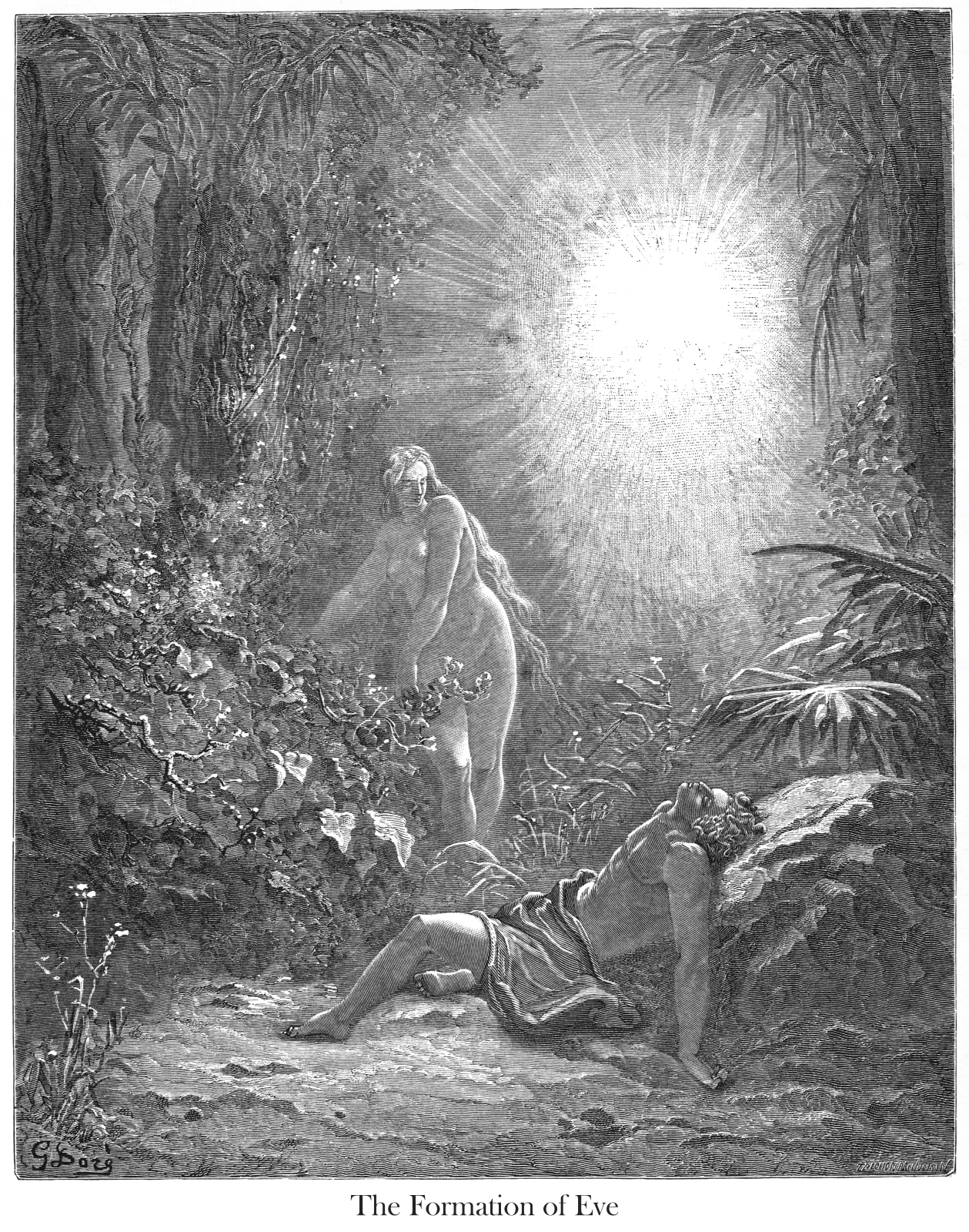
The man sleeps in the foreground, his head tilted back against a rock, one arm hanging limp along his body. Behind him, a woman stands. Her face is turned toward him, but vegetation and distance still separate their bodies. They do not meet: she is already there while he cannot see her.
This distance gives the engraving its own sense of time. In Genesis, God casts the man into a deep sleep, takes one of his ribs, closes up the flesh, then forms the woman and brings her to him. Here, no divine hand removes the rib. The woman appears whole, set apart from the sleeper; the act by which the text unites them remains invisible. By contrast, sleep fills the entire foreground, as though the scene extends beyond the moment before waking.
Above the two figures, a radiant light opens the dark canopy of the trees. No face can be discerned there. This light may be read as a sign of divine presence, without taking the form of the precise act recounted in Scripture. It presides over the space occupied by the man and the woman, while leaving visible the distance that separates them.
The preceding verse explains that the man found no helper like himself among the animals. The following one at last gives the man the word: he will recognize in the woman his flesh and bones. Doré brings the scene to a halt before this utterance. The likeness of their bodies is offered to the eye, but their kinship remains to be recognized by the one who sleeps.
The woman is therefore not reduced to the rib mentioned in the text: she is present in person before she is recognized. The man’s sleep makes room for an act of God that concerns him without depending on him. Between their common origin and the announced encounter lies this silent moment, in which the other already exists.