Gustave Doré · Genesis 1:3
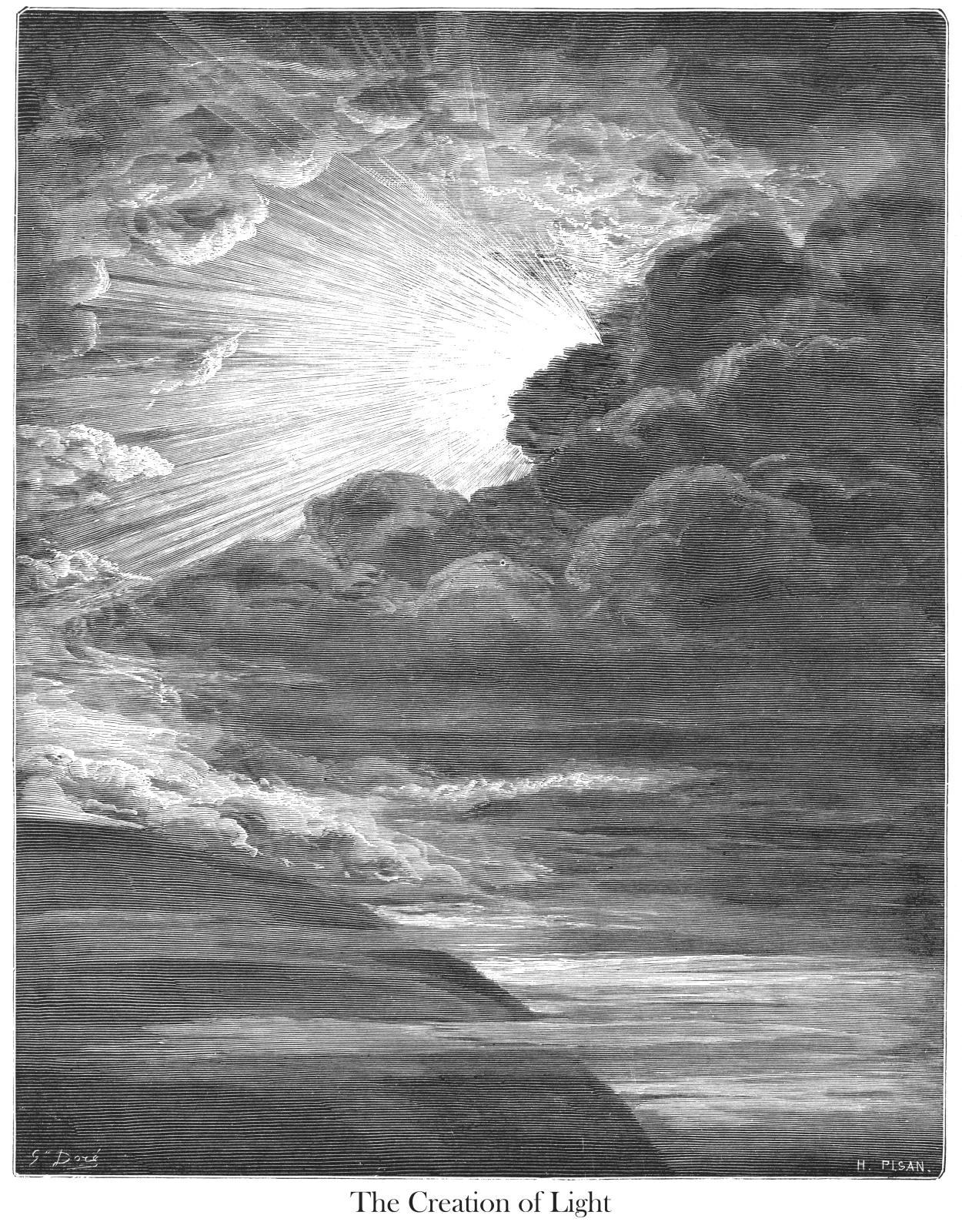
The Creation of Light
Genesis 1:3 · World English Bible (Catholic)
3God said, “Let there be light,” and there was light.
A dark mass on the right interrupts the rays before the eye can even reach their source. From this white opening, high in the engraving, the lines diverge to the left and extend into the clouds. The light does not cover the space all at once: it meets layers, traces their edges, and leaves broad areas of darkness.
Lower down, far from the main brilliance, an expanse crossed by horizontal lines receives a diffuse light. It evokes the waters mentioned before the appearance of light in Genesis. Between this lower part of the image and the radiant opening, clouds occupy almost the entire surface. Their contours, made visible by the light, lend depth to what would otherwise remain indistinct. Light thus appears less as an isolated object than through its effect on a world still difficult to discern.
The verse is very brief: God speaks, and there is light. No gesture accompanies it in the text; no divine figure stands out in the engraving. Here, a propagation of strokes answers the word that cannot be seen. Their convergence suggests a source, without drawing an identifiable heavenly body. The image gives spatial form to the event the narrative states.
The darkness present in the preceding verses has not disappeared from the page. It surrounds the brilliance and heightens its force. The separation God makes in the following verse finds an echo in this distribution of masses, though the engraving does not clearly define their boundaries. In Genesis, light is received as good before it is named day; here, it already makes perceptible an expanse uninhabited by any human gaze. The beginning takes the form of a visibility bestowed.