Gustave Doré · Acts 5:4-5
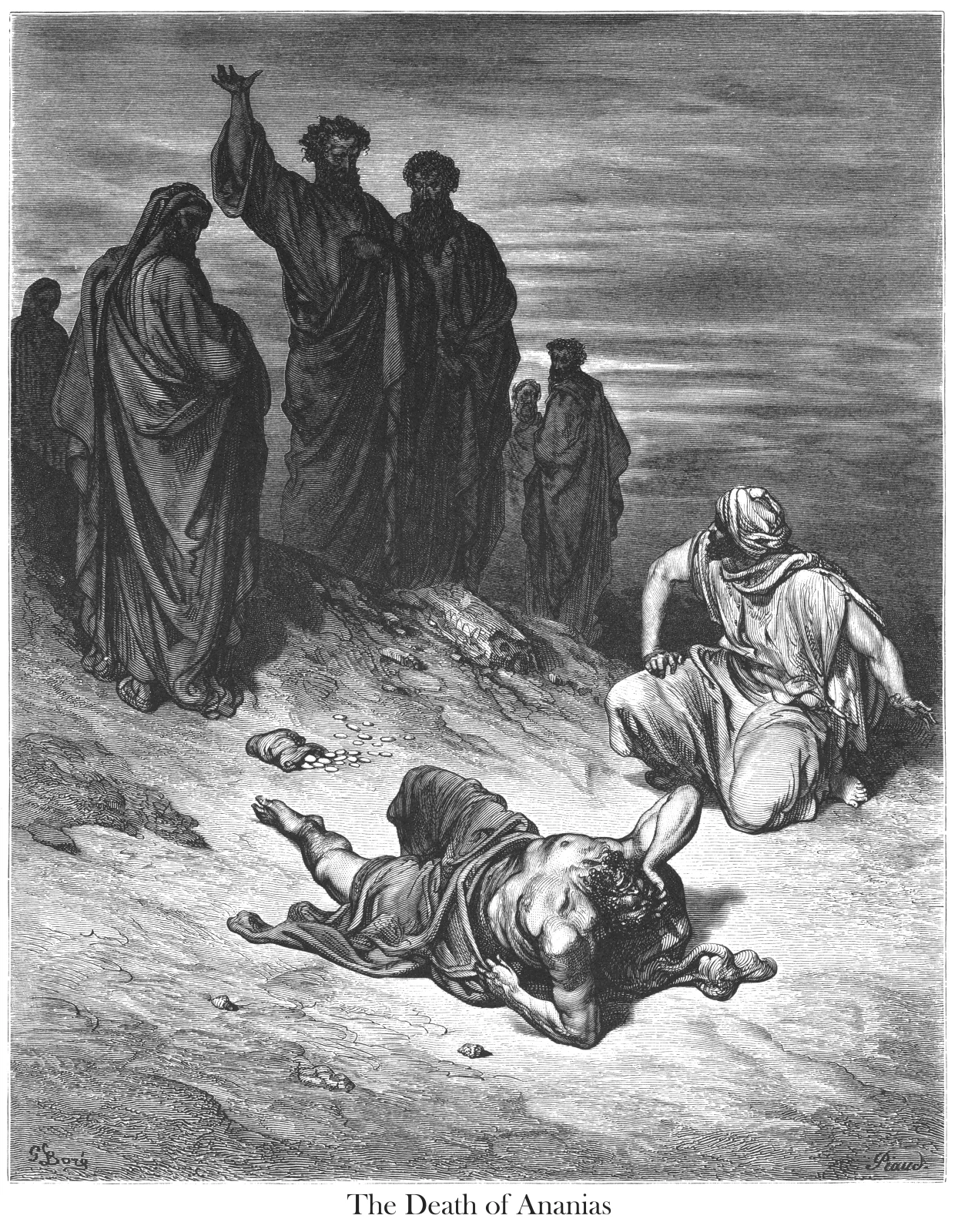
The Death of Ananias
Acts 5:4-5 · World English Bible (Catholic)
4While you kept it, didn’t it remain your own? After it was sold, wasn’t it in your power? How is it that you have conceived this thing in your heart? You haven’t lied to men, but to God.”
5Ananias, hearing these words, fell down and died. Great fear came on all who heard these things.
An open purse lies on the ground, with a few coins scattered beside it. It is small beside the body of Ananias, stretched out in the foreground, but occupies the space separating the dead man from the group standing nearby. The money is no longer in anyone’s hand: it remains there, exposed, while the body has fallen back on the slope.
Above him, a man raises his arm. His gesture dominates the figures gathered behind Ananias and gives visible form to Peter’s words. On the right, a figure kneeling turns toward the group; between him and the standing men, the ground remains largely open. The distance leaves the body isolated, before anyone lifts it or wraps it. The scene is arrested at the moment of the fall, before the burial recounted in Acts.
Peter’s words give the purse an importance that goes beyond its physical presence. Ananias could have kept his field and was free to decide what to do with the proceeds after selling it. The reproach concerns the lie: he kept back part of the money while deceiving those to whom he was speaking. Peter names this lie as an offense not merely against men, but against God. The scattered coins make the money in question visible; they do not, however, allow us to distinguish what was given from what was kept back.
The text immediately links Ananias’s death to the words he has heard, then recounts the fear of those who learn what has happened. The engraving concentrates this sequence into a confrontation: the raised arm, the body on the ground and the abandoned money remain together before the eyes of those present. Peter’s gesture thus takes on a force that the text does not describe; it should not, for all that, be confused with God’s action, which the passage leaves unrepresented. Between the human word and the fallen body, the coins remain silent.