Gustave Doré · John 18:26-27
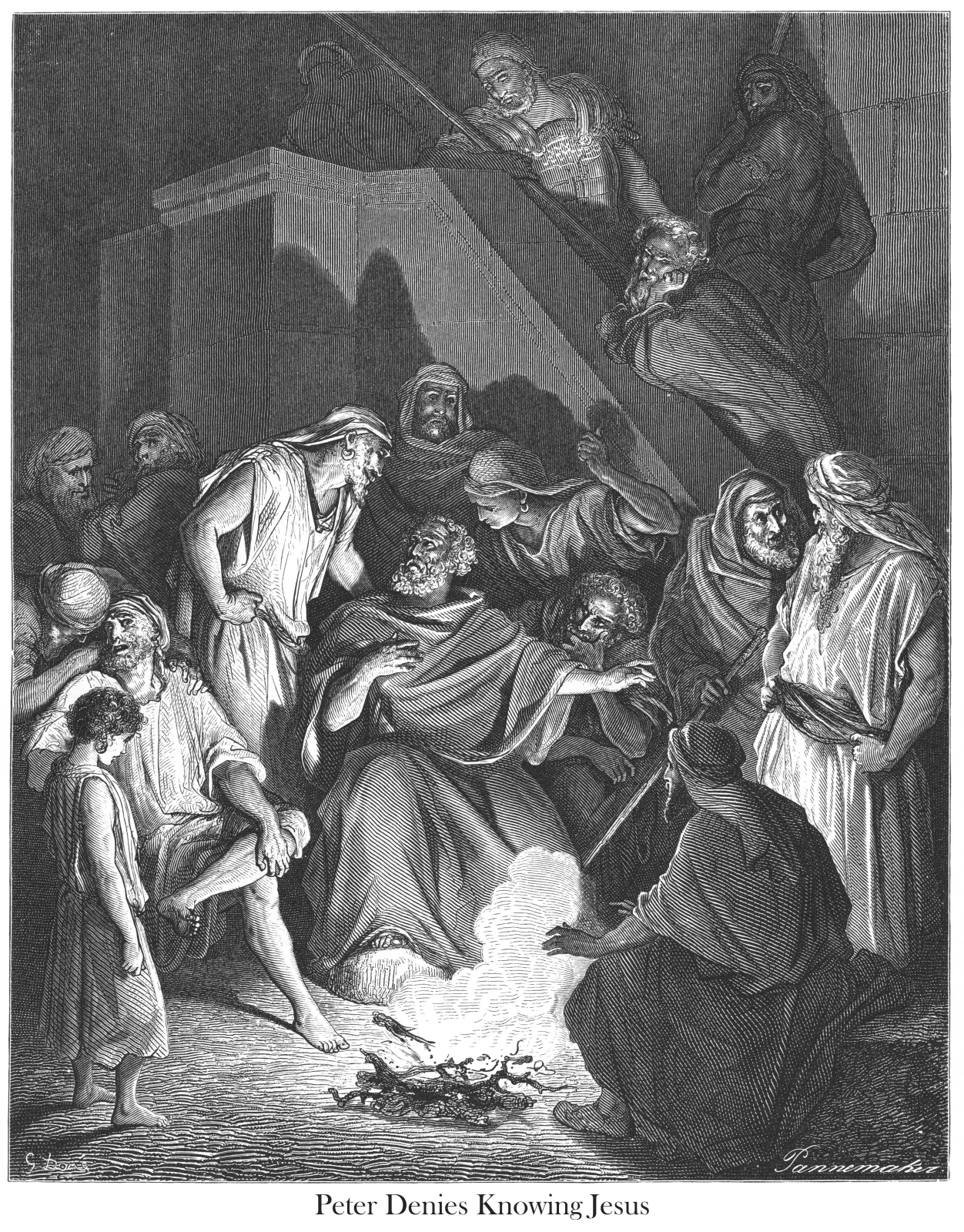
Peter Denies Knowing Jesus
John 18:26-27 · World English Bible (Catholic)
26One of the servants of the high priest, being a relative of him whose ear Peter had cut off, said, “Didn’t I see you in the garden with him?”
27Peter therefore denied it again, and immediately the rooster crowed.
Peter brings one hand to his chest and extends the other toward the men gathered around him. Seated by the fire, he lifts his face toward a woman leaning close over his head. To his left, a standing man bends toward him as well. The disciple is at the center of a tightly packed group; his gesture has little room to unfold.
The fire occupies the foreground. A man seen from behind reaches toward it, while Peter, just behind the flames, must answer the faces drawing near. The warmth that brought the figures together also makes their closeness difficult to escape. Higher up, other figures watch from the staircase. The scene thus extends beyond the circle of immediate interlocutors, without making it appear that everyone is taking part in the questioning.
In John, Peter is warming himself when the decisive question comes. The man who questions him is a servant of the high priest, a relative of the man whose ear Peter wounded. He believes he saw Peter with Jesus in the garden: through a witness’s memory, the place of the arrest returns to the courtyard. The engraving does not allow this relative to be identified with certainty among the figures. It does, however, give visible force to the pressure of the group, concentrated on Peter’s body and hands.
The text then immediately links the fresh denial to the crowing of the rooster. No rooster is visible here; it is the moment of the reply that holds the gaze. The garden and Jesus are absent from the represented space, but their connection with Peter is precisely what the question concerns. The hand brought to his chest can thus be read as the gesture of a man made to speak of himself in order to deny a relationship. Around the fire, the others’ closeness makes the separation he declares all the more palpable.