Gustave Doré · Luke 18:11-13
The Pharisee and the Publican
Luke 18:11-13 · World English Bible (Catholic)
11The Pharisee stood and prayed by himself like this: ‘God, I thank you that I am not like the rest of men: extortionists, unrighteous, adulterers, or even like this tax collector.
12I fast twice a week. I give tithes of all that I get.’
13But the tax collector, standing far away, wouldn’t even lift up his eyes to heaven, but beat his chest, saying, ‘God, be merciful to me, a sinner!’
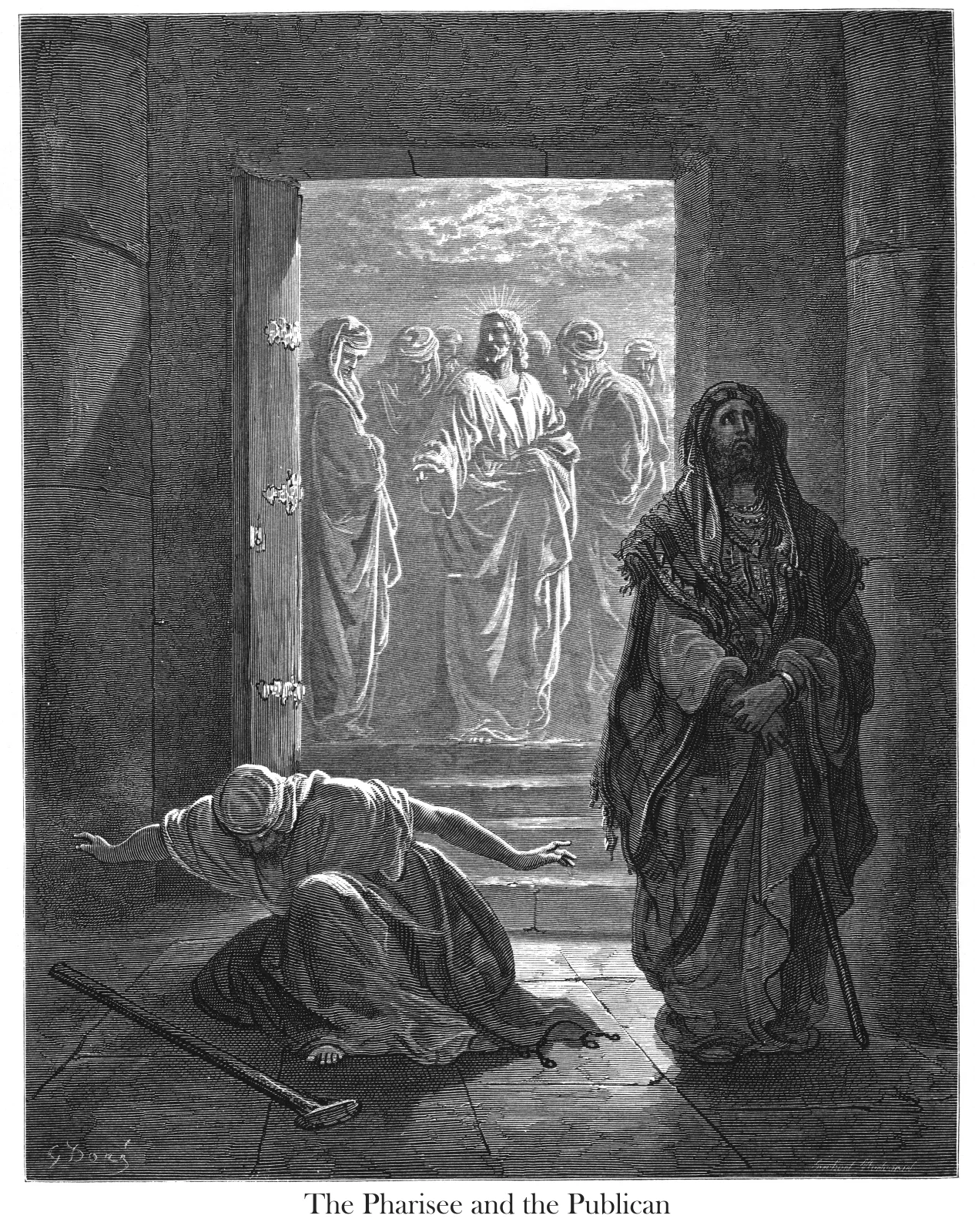
The publican’s arms are spread apart, and his head is bowed so deeply that his face disappears. His body occupies the ground on the left, while on the right the Pharisee stands upright, his hands joined before him and his gaze raised. Between them, the paving stones remain visible: close to one another in the space of the engraving, the two men do not look at each other.
Their clothing heightens the difference. The Pharisee’s ample garments, his ornaments and his staff make for an imposing figure. Wrapped in a simpler garment, the publican seems almost absorbed by the folds around his legs. Yet his outstretched arms give his figure an unexpected breadth. They cross the foreground without meeting anyone.
The words reported by Jesus give this separation its sting. The Pharisee gives thanks by comparing himself with others, and specifically with the publican; the latter asks God to have mercy on him, a sinner. Luke specifies that he stands at a distance, does not dare raise his eyes, and beats his breast. Doré retains the bowed head, but open, outspread hands take the place of the gesture at the breast. The posture of supplication thus becomes legible throughout the body.
In the background, an open doorway frames a radiant figure surrounded by several men. Recognizable by the radiance around his head, Christ appears in the very scene recounted by his parable, although the passage does not place him beside the two men at prayer. This luminous threshold makes the story and the one who tells it coexist. The publican, whose face remains hidden, is beneath his gaze without turning toward him.
The parable goes on to say that this man went down to his house justified. Nothing in his posture makes this verdict visible as a reward: the engraving leaves his plea before us, before any raising up.