Gustave Doré · Luke 4:36-37
Jesus Heals a Demoniac
Luke 4:36-37 · World English Bible (Catholic)
36Amazement came on all and they spoke together, one with another, saying, “What is this word? For with authority and power he commands the unclean spirits, and they come out!”
37News about him went out into every place of the surrounding region.
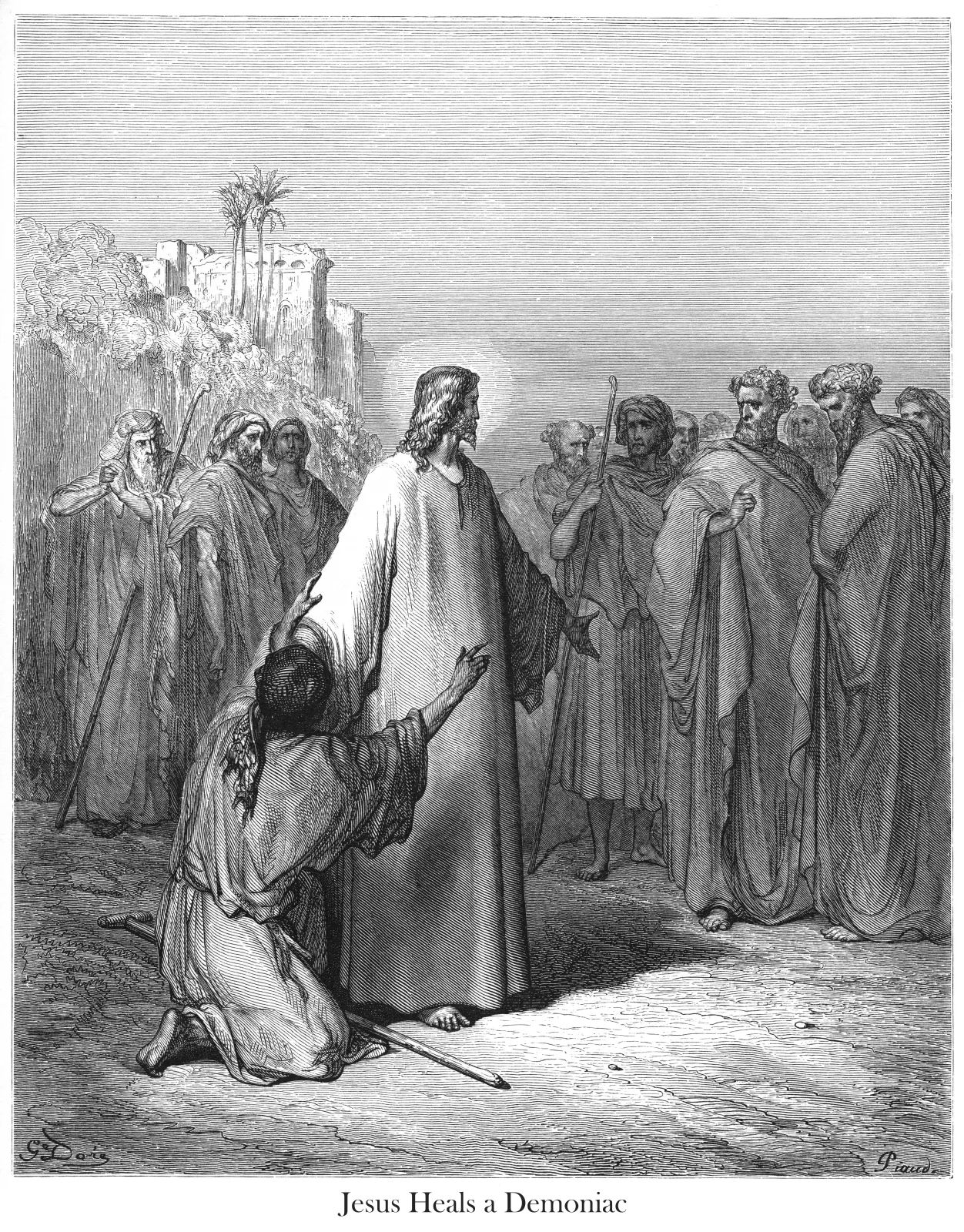
Kneeling before Jesus, a man raises both arms toward him. His face remains hidden, while his figure cuts across the lower part of the light-colored robe. Jesus, for his part, turns his head toward the group gathered on the right. The proximity of the kneeling man and the attention given to the onlookers together shape the scene: the healing concerns one person, but it is also an event whose meaning others are seeking.
On the right, a man raises his index finger near his chest and turns toward his neighbor. This small gesture catches the eye. Around Jesus, the figures do not form an immobile circle: they look at one another, draw closer, and seem to be talking. Their faces and hands give visible form to the question Luke places on their lips: what is this word that commands the unclean spirits? Jesus’s open hand reaches out toward them, though no contact with the sick man accounts for his deliverance.
The passage places the expulsion of the demon in the midst of the assembly. The man had been thrown to the ground, then left unharmed. Here he is kneeling, arms outstretched; no spirit takes shape in the engraving. What his gestures express precisely remains open: supplication, gratitude, or a movement still close to the ordeal. The staff lying diagonally on the ground extends his presence to the very feet of Jesus.
The setting, too, has shifted. Whereas the context in Luke evokes the synagogue, the encounter unfolds in the open air, before a landscape and distant buildings. The text adds that Jesus’s fame spreads throughout the country: the engraving cannot depict this spread, but it captures what might be its first point of origin in the exchanges among the onlookers. The authority of the word remains invisible; its effects, however, pass from a body raised up to the questions of an assembly.