Gustave Doré · Matthew 12:22-25
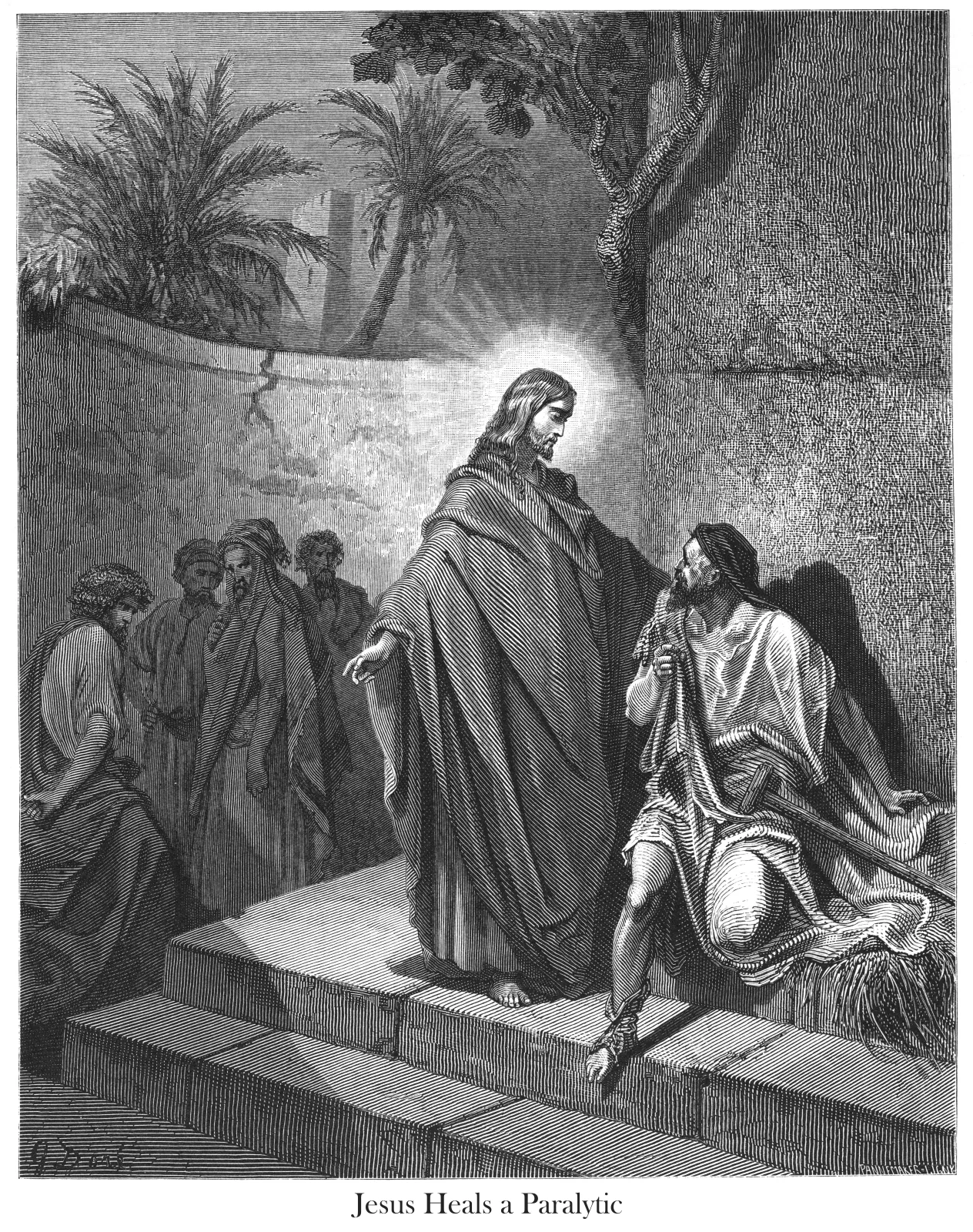
Jesus Heals a Paralytic
Matthew 12:22-25 · World English Bible (Catholic)
22Then one possessed by a demon, blind and mute, was brought to him; and he healed him, so that the blind and mute man both spoke and saw.
23All the multitudes were amazed, and said, “Can this be the son of David?”
24But when the Pharisees heard it, they said, “This man does not cast out demons except by Beelzebul, the prince of the demons.”
25Knowing their thoughts, Jesus said to them, “Every kingdom divided against itself is brought to desolation, and every city or house divided against itself will not stand.
The man seated on the right turns his face toward Jesus. With one hand resting on the stone, he keeps a crutch close beside him, laid across his legs. His body has not yet left the ledge on which he rests. Before him, Jesus stands on the step; his open hand reaches down toward the group below.
This difference in level shapes the scene. The men gathered on the left remain behind the edge of the platform, while Jesus and the seated man occupy the same space. The eye passes from one to the other before returning to the witnesses, several of whose faces are turned toward the encounter. The crutch, meanwhile, gives concrete form to the infirmity announced by the title. The man looks at Jesus, but the engraving leaves him seated still: it holds together the closeness of the gesture and the expectation of movement.
The passage from Matthew associated with the notice, however, speaks of a demon-possessed man who was blind and mute, and who began to see and speak after his healing. It mentions neither difficulty in walking nor a crutch. The inscription beneath the image, moreover, names a paralytic. These indications do not suffice to identify the engraved scene with certainty as the passage given; their divergence calls for verification.
In Matthew, the healing immediately gives rise to opposing statements: the people wonder whether Jesus is the Son of David, while the Pharisees accuse him of acting by the prince of demons. There is nothing that allows us to identify the latter among the engraving’s witnesses. Their presence nevertheless makes room for those who look upon a man whom Jesus has encountered. In the text, this collective gaze becomes a question about the source of the healing; here, it remains suspended before a body still motionless.