Gustave Doré · 2 Kings 19:35
Sennacherib's Army Is Destroyed
2 Kings 19:35 · World English Bible (Catholic)
35That night, the LORD’s angel went out and struck one hundred eighty-five thousand in the camp of the Assyrians. When men arose early in the morning, behold, these were all dead bodies.
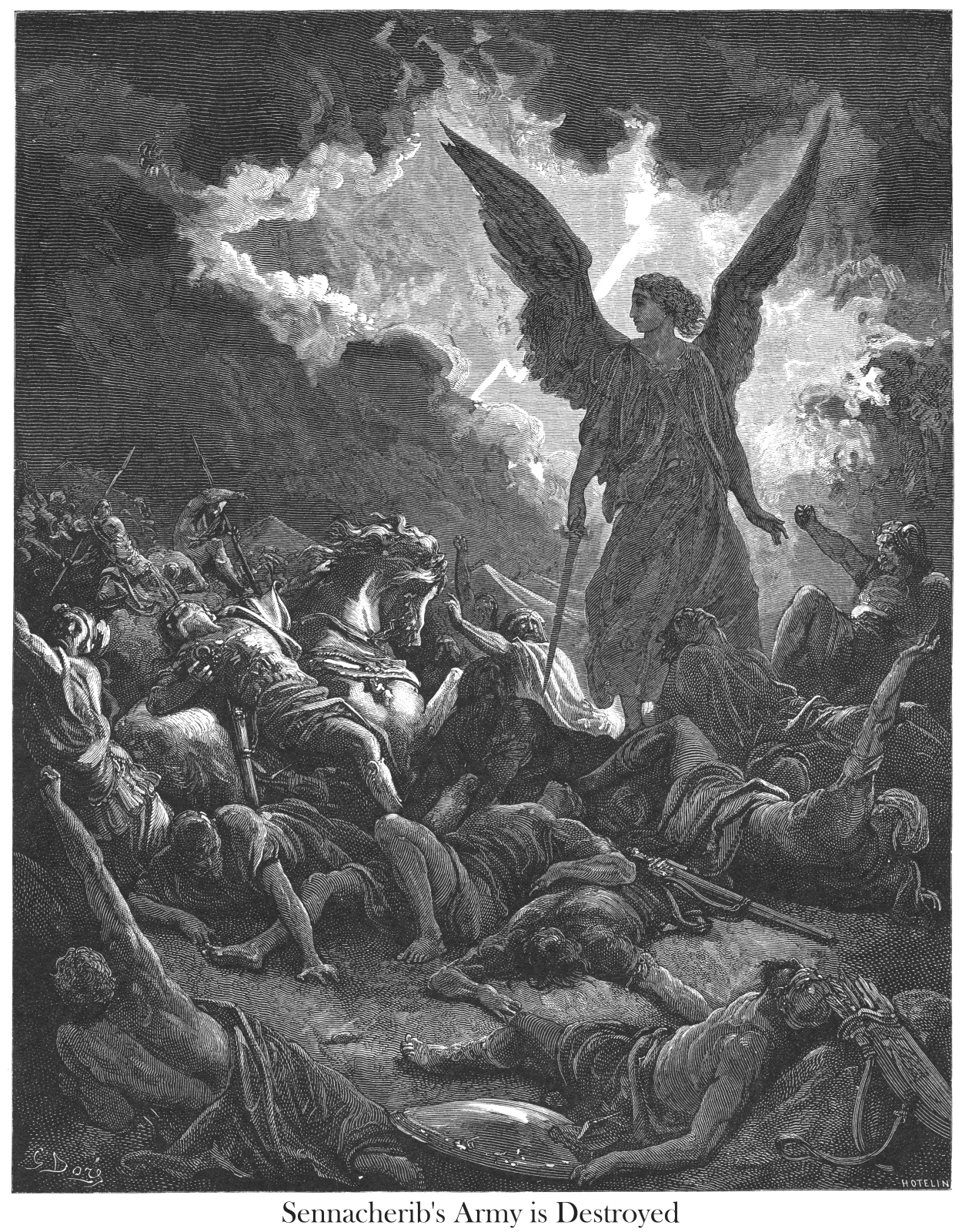
The angel’s sword points toward the ground. It pierces no body; its line descends among the fallen men. Above, the outspread wings cut a luminous opening in the clouds. The figure remains upright, while everything around it seems to have lost its footing.
At its feet, the bodies intersect and overlap. A horse lowers its head among the soldiers; farther off, arms are still raised. These gestures make it impossible to see the camp as a mere field of corpses: the catastrophe is under way, or at least some men are still reacting to it. On the right, a warrior leaning back against the ground raises his fist toward the winged figure. The gesture finds no opponent within reach. The angel looks aside, without answering him, and holds its weapon low.
The Second Book of Kings reports that the angel of Yahweh struck the Assyrians during the night. In the morning, the dead are discovered: the text moves from the intervention to its result without describing the messenger’s action. Doré gives a figure and a sword to this act, which remains out of sight. He also brings together two moments that the verse distinguishes: the nighttime strike and the discovery of the bodies. Those already lying stretched out are beside those whose arms are still raised.
The city promised divine protection does not appear. The gaze remains in the enemy camp, amid the weapons rendered useless and the bodies struck down. In the text, the city’s deliverance is announced before the Assyrian disaster; here, it can be approached only through what happens to those who threatened it. The angel’s presence makes visible an intervention attributed to God, without effacing the weight of the dead whom this protection leaves in the foreground.