Gustave Doré · 1 Samuel 17:50
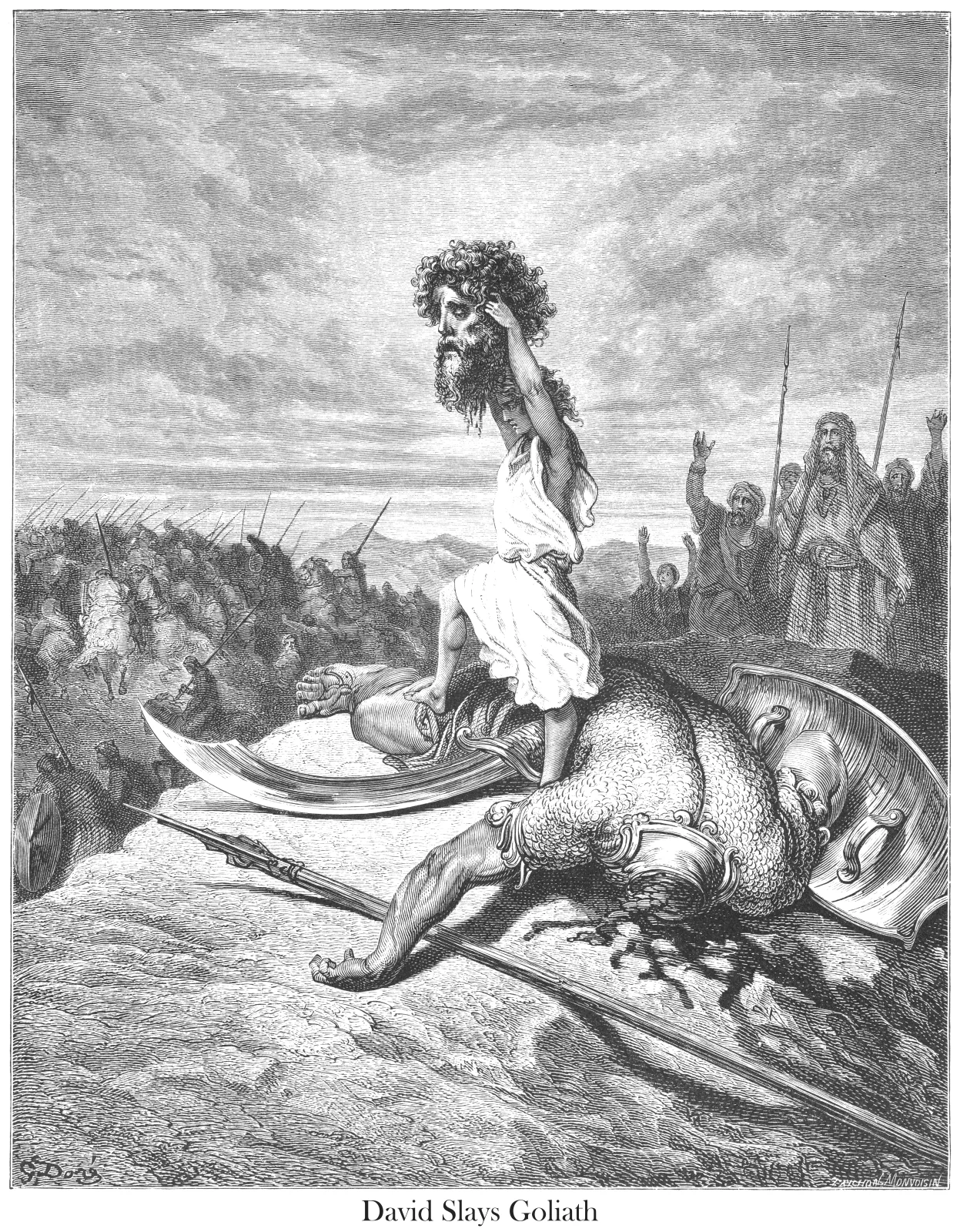
David Slays Goliath
1 Samuel 17:50 · World English Bible (Catholic)
50So David prevailed over the Philistine with a sling and with a stone, and struck the Philistine and killed him; but there was no sword in David’s hand.
David holds Goliath’s head above his own. His raised arm extends the young man’s clear silhouette, while the decapitated Philistine’s body occupies almost the entire width of the foreground. The vanquished man’s size remains unmistakable: even on the ground, he forms a mass on which David braces himself. Victory does not erase the disparity between the adversaries; it reverses their positions.
A broad, curved sword cuts across the space in front of David’s legs. Its blade is as striking as the body to which it belonged. Yet the verse chosen emphasizes that the victor had no sword in his hand: David struck with a sling and a stone. The engraving depicts a moment somewhat later. According to the immediate continuation of the text, David takes the Philistine’s sword and cuts off his head. The giant’s weapon, having failed to defend him, has served to complete his defeat.
The raised head makes that defeat visible in a way the outstretched body alone would not. On the right, men raise their arms; on the left, an armed crowd moves away. The narrative reports that the Philistines flee at the sight of their dead champion, and that the men of Israel and Judah then pursue them. David’s gesture thus stands out between the motionless body and the movement of the troops: it makes the victory present to those beyond the single combat.
The stone and the sling, decisive in verse 50, give way here to signs of what followed. The text makes clear that a superior force was struck down without a sword; the engraving leaves before our eyes the weapon taken from the adversary and the violence of the final blow. David’s apparent frailty erases neither his enemy’s body nor the bloody cost of victory.