Gustave Doré · 1 Samuel 15:33
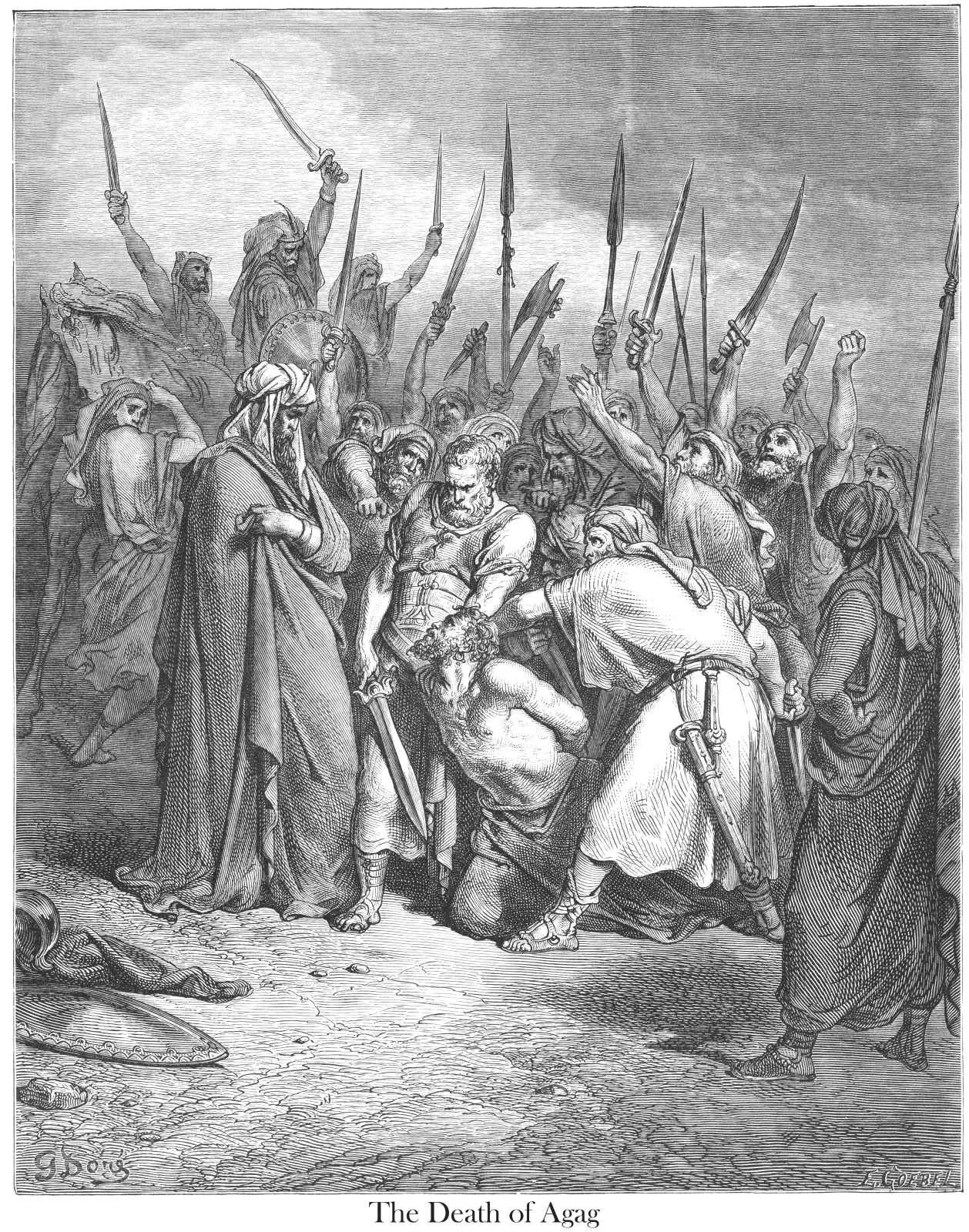
The Death of Agag
1 Samuel 15:33 · World English Bible (Catholic)
33Samuel said, “As your sword has made women childless, so your mother will be childless among women!” Then Samuel cut Agag in pieces before the LORD in Gilgal.
Kneeling, his torso bare, Agag throws his head back. A hand grips his hair; his body is hemmed in by the men standing around him. Above this prostrate figure rises a forest of blades and spears. Their movement climbs toward the sky, while the gaze returns to the captive and to the sword held point downward, very close to him.
On the left, a figure wrapped in a long cloak keeps his head bowed. The heavy mass of his garment forms a screen between the almost empty foreground and the crowd pressed around Agag. In this group, raised arms and the profusion of weapons give the execution a public dimension. Yet no blow has been struck against the king’s body: the engraving suspends the gesture at the brink of the violence that the text states without evasion.
According to the book of Samuel, Samuel first pronounces a sentence. Agag’s sword has deprived women of their children; his own mother will in turn be deprived of her son. Then Samuel cuts him to pieces before the LORD at Gilgal. The words establish a terrible correspondence between the deaths caused by the king and the one that awaits him. The women and the mother to whom they give a place remain absent from the engraving. In their stead, armed men surround the condemned man.
The text also specified that Agag came forward believing that the bitterness of death had passed. His body’s position makes this confidence impossible to recover: he is already held beneath the gaze of others. As for the presence of the LORD, before whom Samuel acts, it takes no visible form. What remains is this tightly packed gathering, where a sentence attributed to Samuel becomes a scene presented to a crowd in arms. The engraving thus leaves open the difficulty of the verse: holding together the violence suffered by families, the violence that strikes Agag, and the act performed before God.