Gustave Doré · Judges 9:52-53
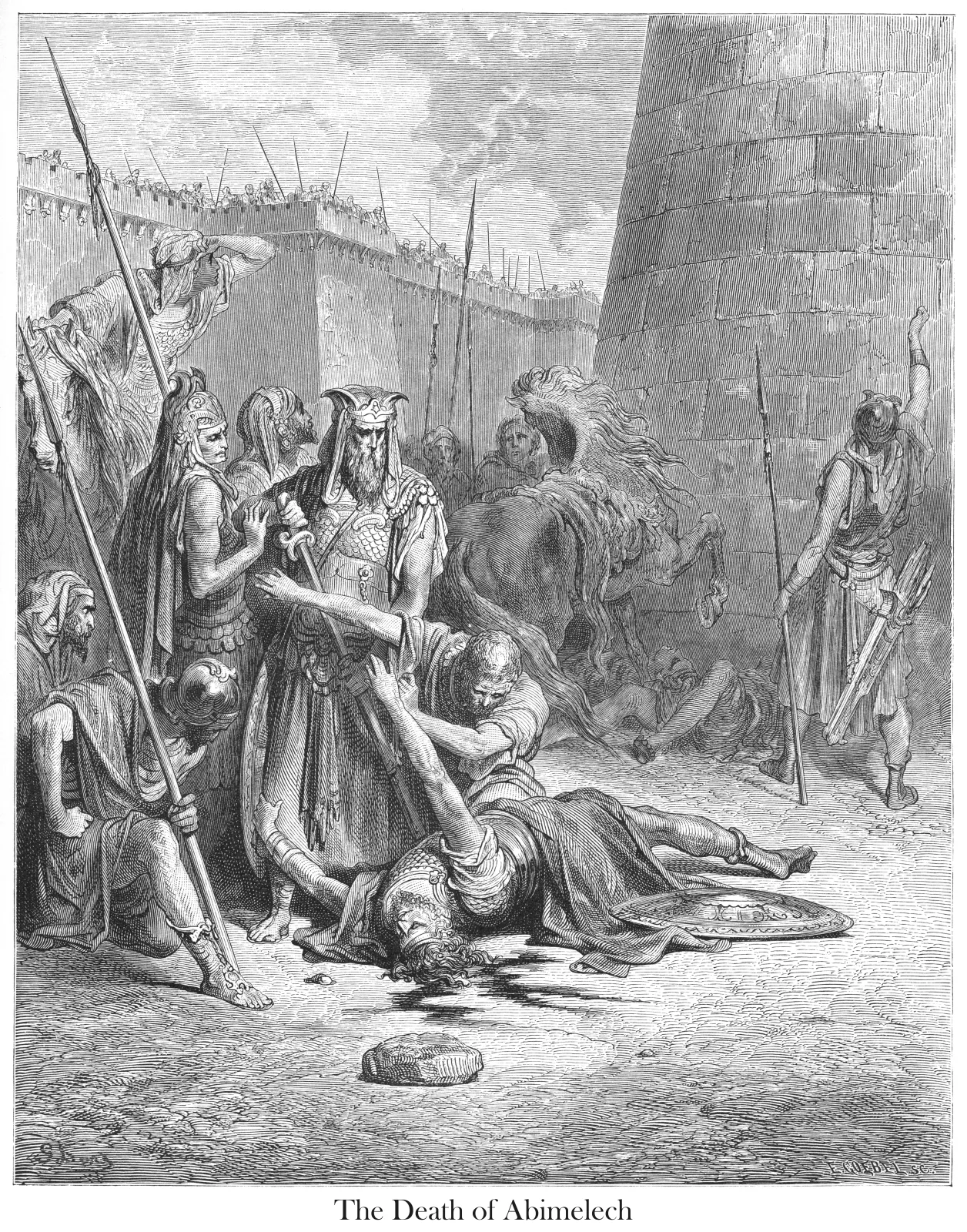
The Death of Abimelech
Judges 9:52-53 · World English Bible (Catholic)
52Abimelech came to the tower and fought against it, and came near to the door of the tower to burn it with fire.
53A certain woman cast an upper millstone on Abimelech’s head, and broke his skull.
In the foreground, a piece of stone lies some distance from Abimelech’s head. The leader’s body is stretched across the ground; blood trickles beneath his hair. Yet his raised hand, near the men surrounding him, maintains a tension in this overturned body. The title announces a death; the gesture still shows a man struggling with those who stand around him.
Behind him, the tower occupies almost the entire height of the engraving. Its summit lies outside the frame. On the right, a soldier raises his arm toward the wall; farther off, figures crowd the ramparts. The eye thus travels upward from the stone to a height whose edge escapes view. The woman who threw the fragment of millstone cannot be identified. The fallen object remains, separated from her gesture and from its place of origin.
The Book of Judges specifies the sequence of events: Abimelech approached the gate to set it on fire; a woman then threw a piece of millstone onto his head, crushing his skull. The gate and the fire are not visible here. Doré focuses attention on the wounded man beneath the wall and on the reactions of those around him, rather than on the attack itself.
The immediate continuation of the text gives particular weight to this gathering. Abimelech asks his armour-bearer to finish him off, so that no one will say a woman killed him. The engraving does not allow us to identify this young man with certainty among the figures bending over him, or to determine the exact moment of their exchange. But the stone remains before the group, silent proof of what the leader would like to erase from memory. The wounded man’s words seek to dictate the account of his death; the fragment on the ground preserves its cause.