Gustave Doré · Numbers 16:32
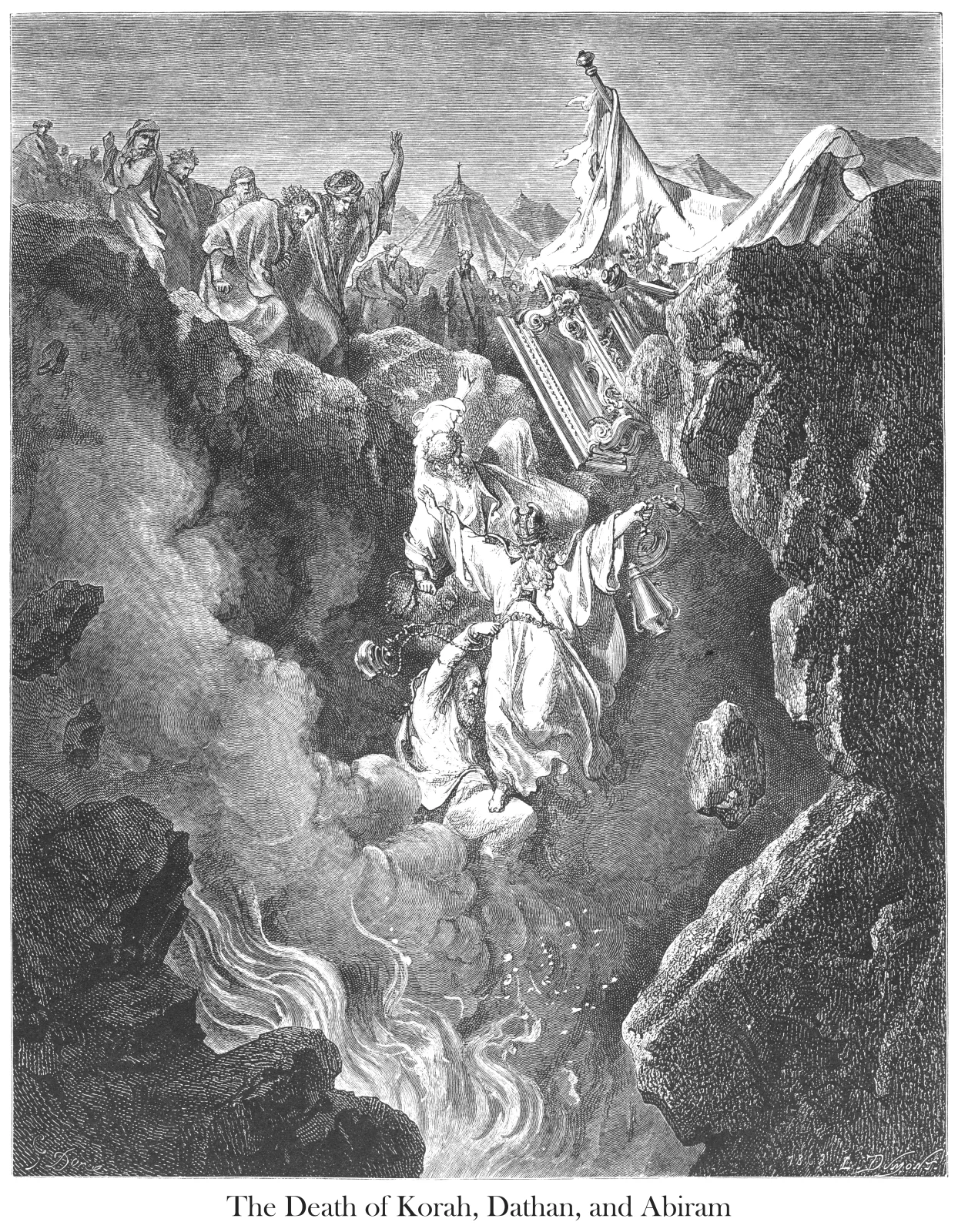
The Death of Korah, Dathan, and Abiram
Numbers 16:32 · World English Bible (Catholic)
32The earth opened its mouth and swallowed them up with their households, all of Korah’s men, and all their goods.
At the edge of the fissure, a man raises his arm while others lean over the void. Just below, an outstretched hand still seems to be reaching for the bank. But the bodies have already tipped over: before our eyes, the distance separating them from the camp widens.
The cleft occupies almost the entire height of the engraving. Its dark walls hem in the falling figures, whose light garments remain visible above the flames and smoke. On the right, a tent comes apart and an ornate piece of furniture slides after it. This detail gives the fall a particular breadth: it is not isolated bodies that vanish, but an inhabited place losing its ground. Higher up, the tents still standing set the catastrophe in the midst of the camp.
The Book of Numbers says that the earth opens its mouth and swallows the families, Korah’s people, and their possessions. The piece of furniture dragged into the fissure gives a precise form to these possessions, which the text does not detail. The engraving holds on to the moment of engulfment, before the earth closes over those who descend alive to the abode of the dead. It makes their fall visible where the narrative also announces their disappearance.
The flames, by contrast, are not mentioned in the verses provided. They give the chasm a presence that the words “abode of the dead” do not describe here. On the bank, the figures still close to the breach do not clearly depict all Israel’s flight, reported later; their gestures hold together both terror and the victims’ proximity.
The words spoken before the rupture designate this event as a sign of contempt for Yahweh. The engraving lets us feel the severity of this judgment in the very collapse: possessions and dwellings follow their occupants, and the camp remains at the edge of absence.