Gustave Doré · Luke 15:20-21
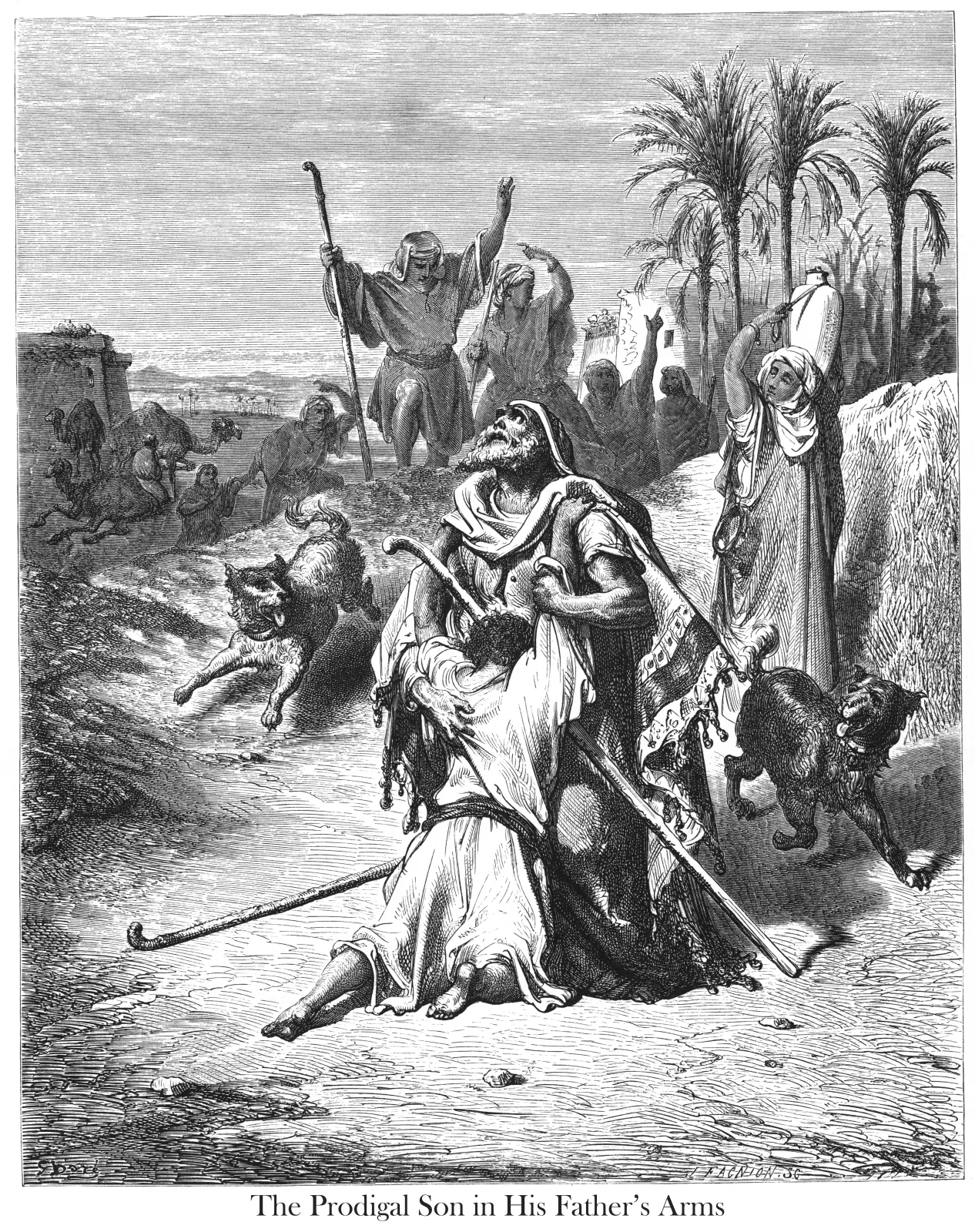
The Prodigal Son in His Father's Arms
Luke 15:20-21 · World English Bible (Catholic)
20“He arose and came to his father. But while he was still far off, his father saw him and was moved with compassion, and ran, fell on his neck, and kissed him.
21The son said to him, ‘Father, I have sinned against heaven and in your sight. I am no longer worthy to be called your son.’
The son's face has disappeared against his father's chest. Kneeling, his bare feet stretched out along the path, he clings to him; the father holds him with one arm and lifts his face toward the sky. Their bodies form a compact mass in the foreground, while the folds of the son's garment spread across the ground. Before one can make out either man's features, one sees the weight of the one who has returned and the embrace that receives him.
In the Gospel according to Luke, the father sees his son while he is still far away, runs to meet him, and embraces him. This movement abolishes the distance. Doré captures the moment when their bodies have come together: the path remains visible behind them, but the return is now contained in this contact. The son, who says that he has sinned and is no longer worthy to bear his name, cannot be heard in the engraving. His buried face nevertheless leaves room for the silence of confession.
Around the embrace, the encounter extends along the whole path. Figures approach from the background, some with their arms raised; two dogs run on either side of the central group. Their divergent movements bring out the stillness of the two men. On the right, a woman carrying a jar has turned toward them. The scene is not enclosed within an encounter between two alone: the return becomes visible to those near the house.
The son's bare feet still draw the eye. In the immediate continuation of the text, the father asks his servants to bring him shoes, as well as a robe and a ring. Here, these tokens have not yet been given. The son's poverty remains exposed at the very moment he is welcomed. His declared unworthiness does not precede the father's love as a condition to be met: in the text, it is the father who runs first.