Gustave Doré · 1 Kings 4:29-34
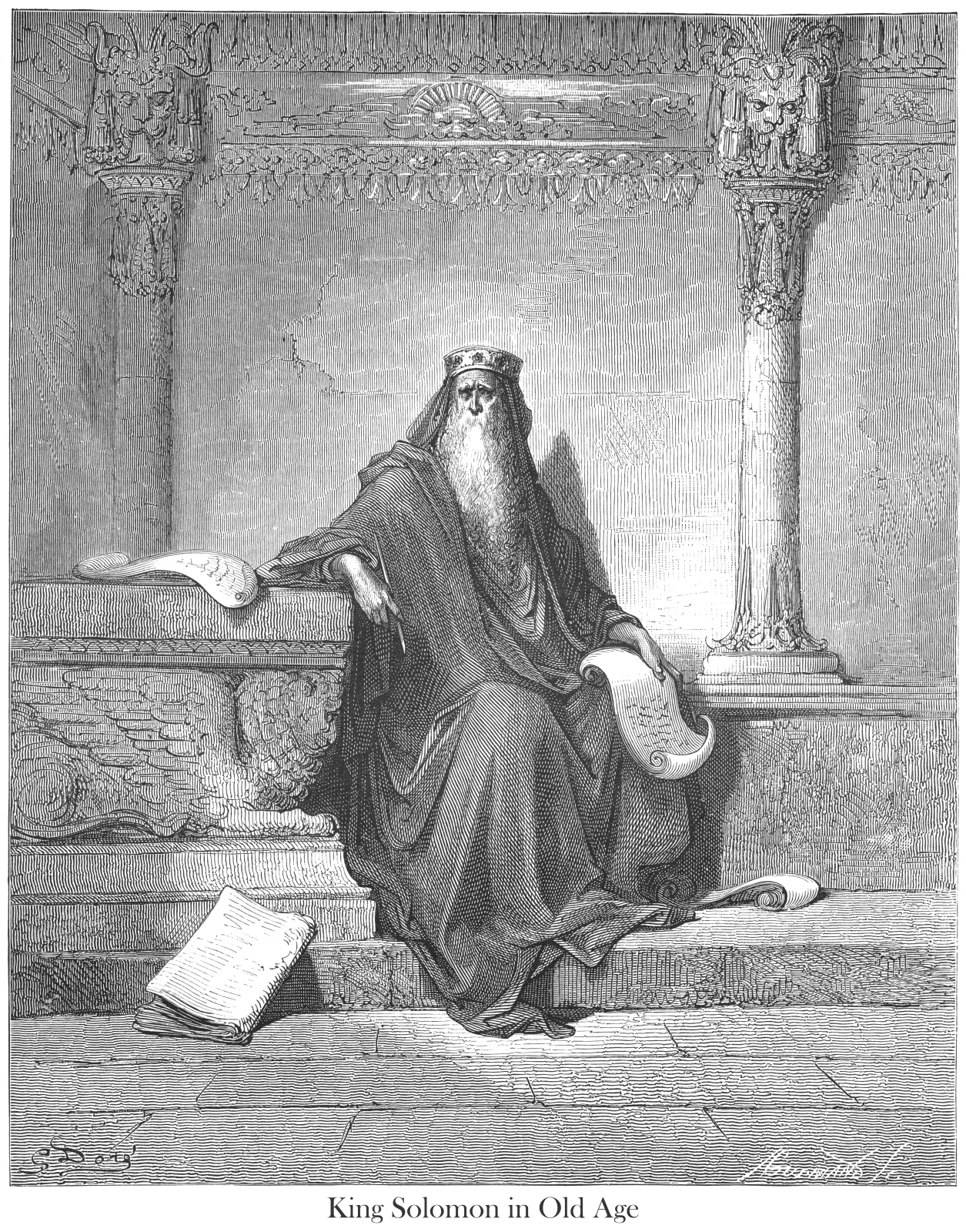
King Solomon in Old Age
1 Kings 4:29-34 · World English Bible (Catholic)
29God gave Solomon abundant wisdom, understanding, and breadth of mind like the sand that is on the seashore.
30Solomon’s wisdom excelled the wisdom of all the children of the east and all the wisdom of Egypt.
31For he was wiser than all men—wiser than Ethan the Ezrahite, Heman, Calcol, and Darda, the sons of Mahol; and his fame was in all the nations all around.
32He spoke three thousand proverbs, and his songs numbered one thousand five.
33He spoke of trees, from the cedar that is in Lebanon even to the hyssop that grows out of the wall; he also spoke of animals, of birds, of creeping things, and of fish.
34People of all nations came to hear the wisdom of Solomon, sent by all kings of the earth who had heard of his wisdom.
A scroll unfurls across Solomon’s knee. His hand holds its edge, while the other rests on a tablet, near a second scroll. Yet the king does not seem to be reading: beneath the crown, his face is turned forward, and his long white beard falls over his dark garment. Around him, writings lie open or abandoned on the steps. They accompany his presence without being enough to explain it.
Solomon is alone in a monumental space. The columns and the frieze crowded with figures tower over his seat; to his left, a sculpted winged creature seems to guard the royal throne. But the broad wall behind him remains almost bare. This light surface sets apart the crowned head and lends still greater weight to the figure’s immobility. The sumptuous setting leads to no audience: no one is there to receive his words.
Yet the Book of Kings tells how men from all peoples came, wishing to hear Solomon’s wisdom. It measures its scope through proverbs and songs, but also through the subjects addressed: trees, from the cedar to the hyssop, animals, birds, and fish. None of these listeners or creatures appears in the engraving. The scrolls give material form to the abundance of words, though their contents cannot be identified.
The title adds old age to this portrait, although the cited passage does not specify the king’s age. The beard and the scattered writings invite us to see wisdom as the possession of a man at the end of a long life. Yet the text first names its source: God gives it to Solomon. The king remains alone with the signs of what he has received; the words meant for the peoples are here held within the silence of the scrolls.