Gustave Doré · 1 Samuel 19:11-12
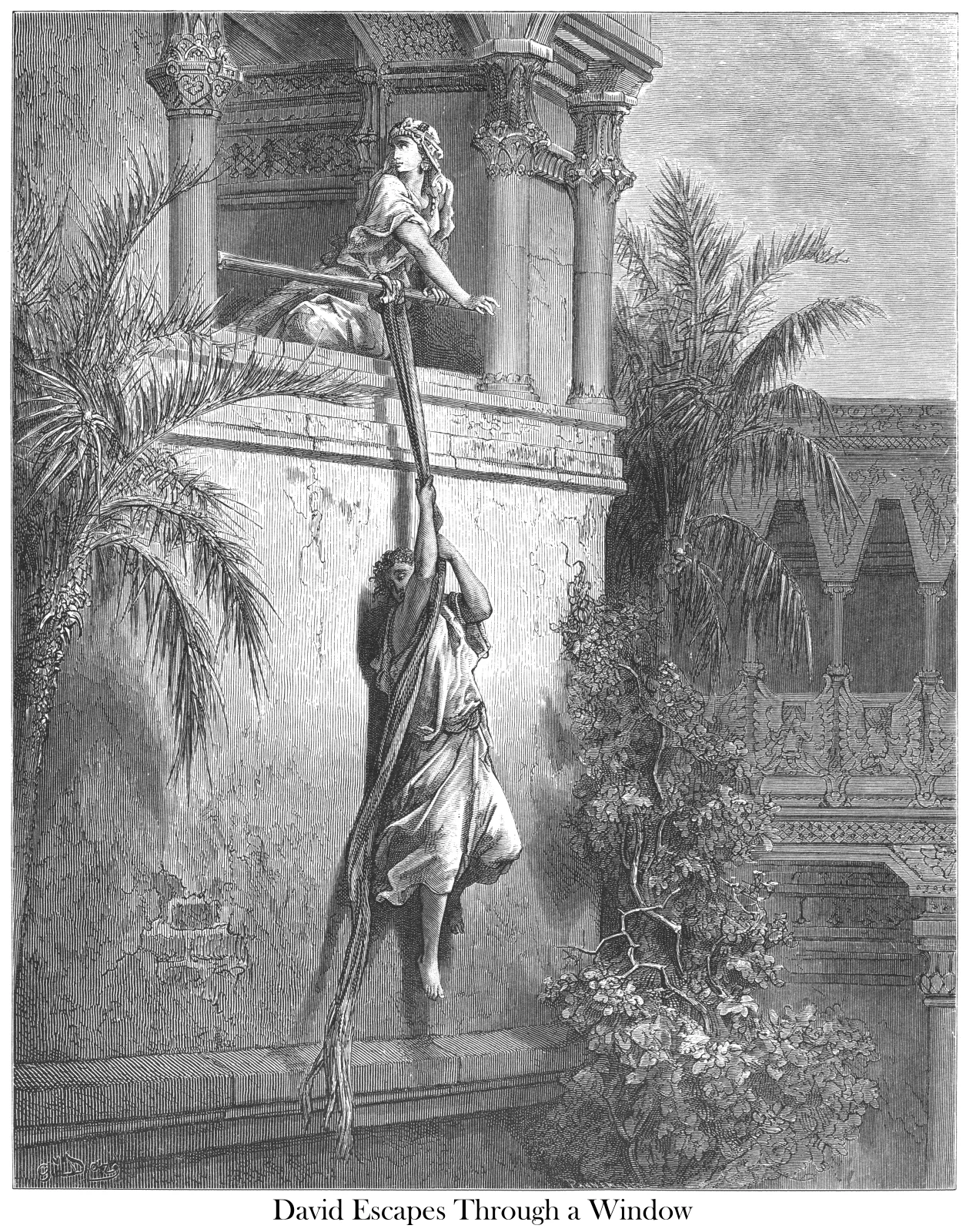
David Escapes through a Window
1 Samuel 19:11-12 · World English Bible (Catholic)
11Saul sent messengers to David’s house to watch him and to kill him in the morning. Michal, David’s wife, told him, saying, “If you don’t save your life tonight, tomorrow you will be killed.”
12So Michal let David down through the window. He went away, fled, and escaped.
David’s feet have not yet reached the cornice. Suspended against the wall, he clings to a long rope that hangs from the window and extends far below him. His body follows the vertical line of the façade; his raised arms express the effort needed to leave the house. The escape is not yet a flight: it depends on this hold.
Above, Michal leans out of the window. With one hand resting near the rope, she turns her head inward, while David descends beyond her gaze. This shared movement gives the scene its tension: one is moving away, the other remains at the threshold, alert to what may come after her. Between them, the rope maintains a physical link even as the distance grows.
The First Book of Samuel gives this departure a precise urgency. Saul has sent men to watch the house so that they can kill David in the morning; Michal warns her husband and lets him down through the window. The text quickly brings the escape to its conclusion: David goes away and is saved. The engraving stops before that outcome. It unfolds across the height of the wall a gesture that Scripture states in a few words, and gives it a visible means, this rope, which the passage does not mention.
Saul’s men are nowhere to be seen. Yet their threat is measured by Michal’s vigilance and by the descent, still unfinished. The following verse recounts another initiative on her part: she places a teraphim in the bed to deceive those who will come looking for David. Here, she has not yet left the window. The salvation announced in the text takes the form of concrete human aid, fragile so long as David remains suspended against the wall.