Gustave Doré · Judges 7:22-23
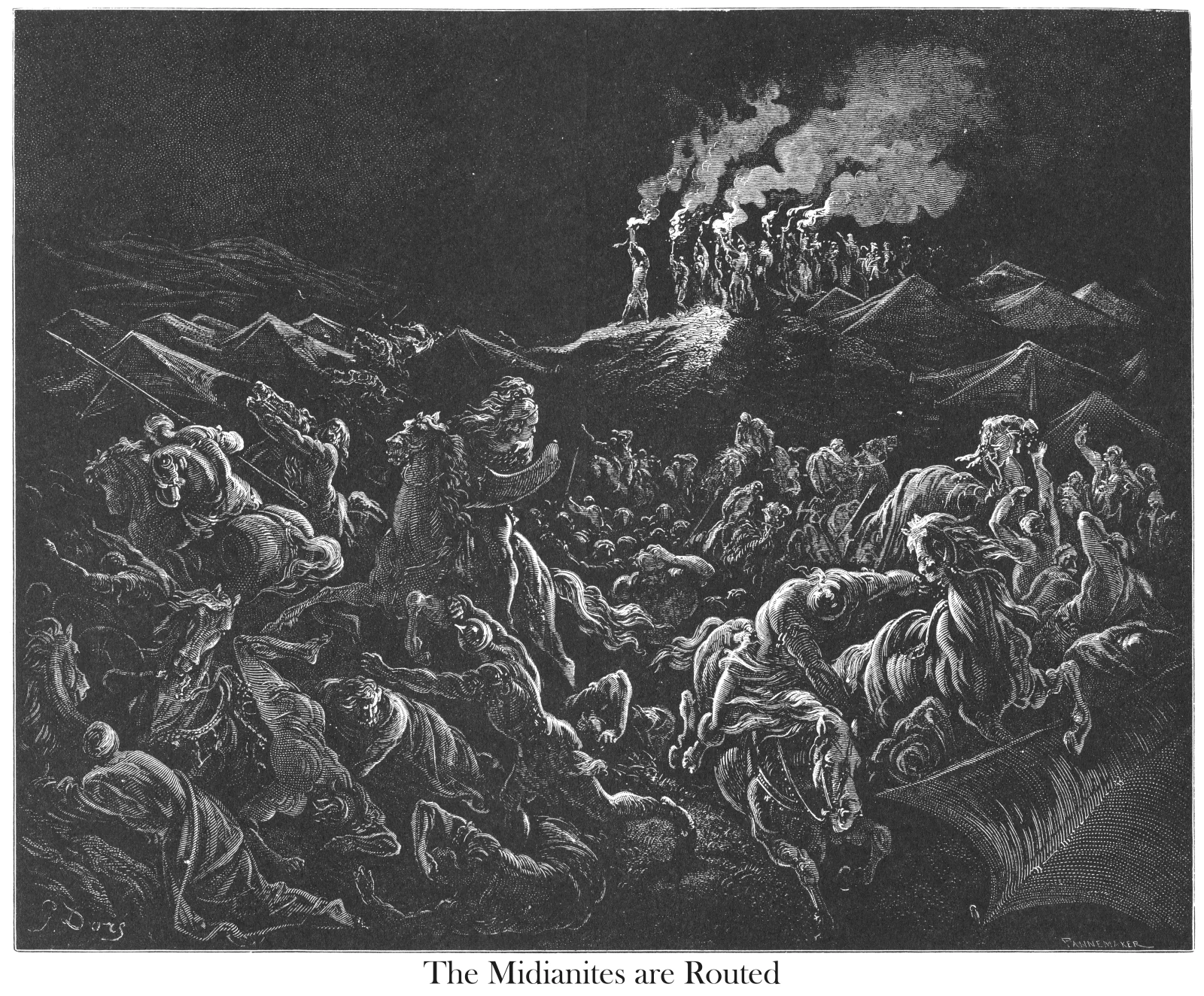
The Midianites Are Routed
Judges 7:22-23 · World English Bible (Catholic)
22They blew the three hundred trumpets, and the LORD set every man’s sword against his fellow and against all the army; and the army fled as far as Beth Shittah toward Zererah, as far as the border of Abel Meholah, by Tabbath.
23The men of Israel were gathered together out of Naphtali, out of Asher, and out of all Manasseh, and pursued Midian.
In the foreground, a horseman bends over his mount’s neck, while horses and men collide or fall around him. No common movement emerges from this crowd: bodies move in different directions, and weapons are raised amid the fugitives. Yet the tents lining the scene make it possible to recognize a camp, now given over to confusion.
Far above this mêlée, on a rise, a small band stands out. Arms hold aloft torches whose smoke spreads through the night. The distance is decisive: these men overlook the camp without joining the combat that their presence accompanies. Their comparatively calm line makes the mass stirring below seem still more disorderly. The light does not reveal an ordered battlefield; it illuminates an army falling apart from within.
The Book of Judges attributes this rout to Yahweh: while the three hundred men sound the trumpet, he turns the sword of the Midianites against one another. The engraving gives form to this confusion, without making it possible to distinguish every adversary or follow every blow. It also makes room for flight, but leaves outside its frame the precise route named in the text and the pursuit undertaken by the men of Naphtali, Asher, and Manasseh.
The torches, by contrast, draw the eye toward those who remain at a distance. Their glow and smoke make visible, where the passage emphasizes the sounding of the trumpets, the signal given around the camp. Between the occupied height and the mêlée, no gesture directly represents divine action. This remains the text’s assertion: victory comes there when the camp’s strength turns against itself.